Our Story
Same mission.
New medium.
The original Multilith revolutionized document duplication. We're revolutionizing context duplication for the AI age.
Why "Multilith"?
A name with 90 years of history—and a perfect parallel.
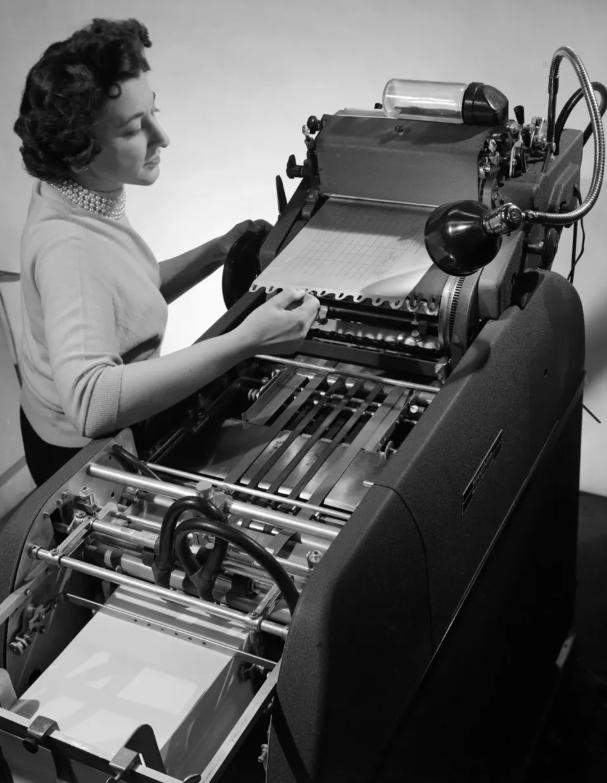
The Multilith duplicating machine, circa 1955. Before Xerox, before digital, this was how offices made copies.
Source: Internet Archive
In 1930, the Addressograph-Multigraph Corporation introduced the Multilith—a revolutionary offset printing machine that brought document duplication to every office in America.
Before Multilith, making copies was expensive, slow, and required specialized equipment. The Multilith changed that. It was compact enough for an office, simple enough for a secretary to operate, and affordable enough that any business could own one. It democratized duplication.
For fifty years, "Multilith" was synonymous with office copying. The machines hummed in back offices across the world, turning single documents into hundreds of copies with the push of a button.
When we discovered this history, the parallel was impossible to ignore. The original Multilith solved the problem of document duplication—how do you efficiently copy physical information? We're solving the problem of context duplication—how do you efficiently copy organizational knowledge to AI tools?
Same mission. New medium.
| Original Multilith (1930s–80s) | Multilith AI (2025) | |
|---|---|---|
| Core function | Duplicated documents at scale | Duplicates organizational knowledge at scale |
| What it replaced | Manual copying, expensive print shops | Manual context-explaining, repeated conversations |
| Democratized access to | Document reproduction | Organizational memory for AI |
| Who benefits | Every office worker | Every developer using AI tools |
| Key innovation | Compact, affordable offset printing | MCP-based context injection |
| Tagline | "The office duplicating machine" | "The AI context duplicating machine" |
Who's Building This
Scott Coller
Founder & CEO
I've spent the last decade at the intersection of healthcare data and AI. As a pharmacist turned product builder, I've led teams that processed billions of medical records and built products that reached massive scale at leading healthcare analytics companies.
As a successful intrapreneur, I saw firsthand how organizational knowledge—clinical protocols, underwriting rules, architectural decisions—lived in people's heads, not in systems. Every new hire, every new project, every new AI tool had to start from zero.
When AI coding tools exploded in 2023, I watched the same pattern repeat. Brilliant tools, completely context-blind. Developers spending as much time explaining context as writing code. I knew there had to be a better way.
Multilith is that better way. It's the organizational memory layer I wish I'd had for the last ten years. And now I'm building it for every team that's tired of being the context bridge between their knowledge and their AI tools.
What We Believe
The best AI tools are invisible. They don't demand your attention—they amplify your capabilities without you noticing.
We believe organizational knowledge shouldn't live in people's heads. It should be externalized, structured, and accessible—to humans and AI alike.
We believe the future of development is sustained flow—hours of deep creative work, uninterrupted by context-switching. Multilith makes that possible.
🔮 Invisible by Design
Multilith works behind the scenes. No new UI to learn, no workflow changes. Just smarter AI tools.
🧠 Memory That Compounds
Every decision you document makes your AI tools smarter. Knowledge builds on knowledge.
⚡ Flow Over Features
We measure success by how long you stay in flow, not by how many features we ship.
Join the duplication revolution
Be among the first to give your AI tools organizational memory.